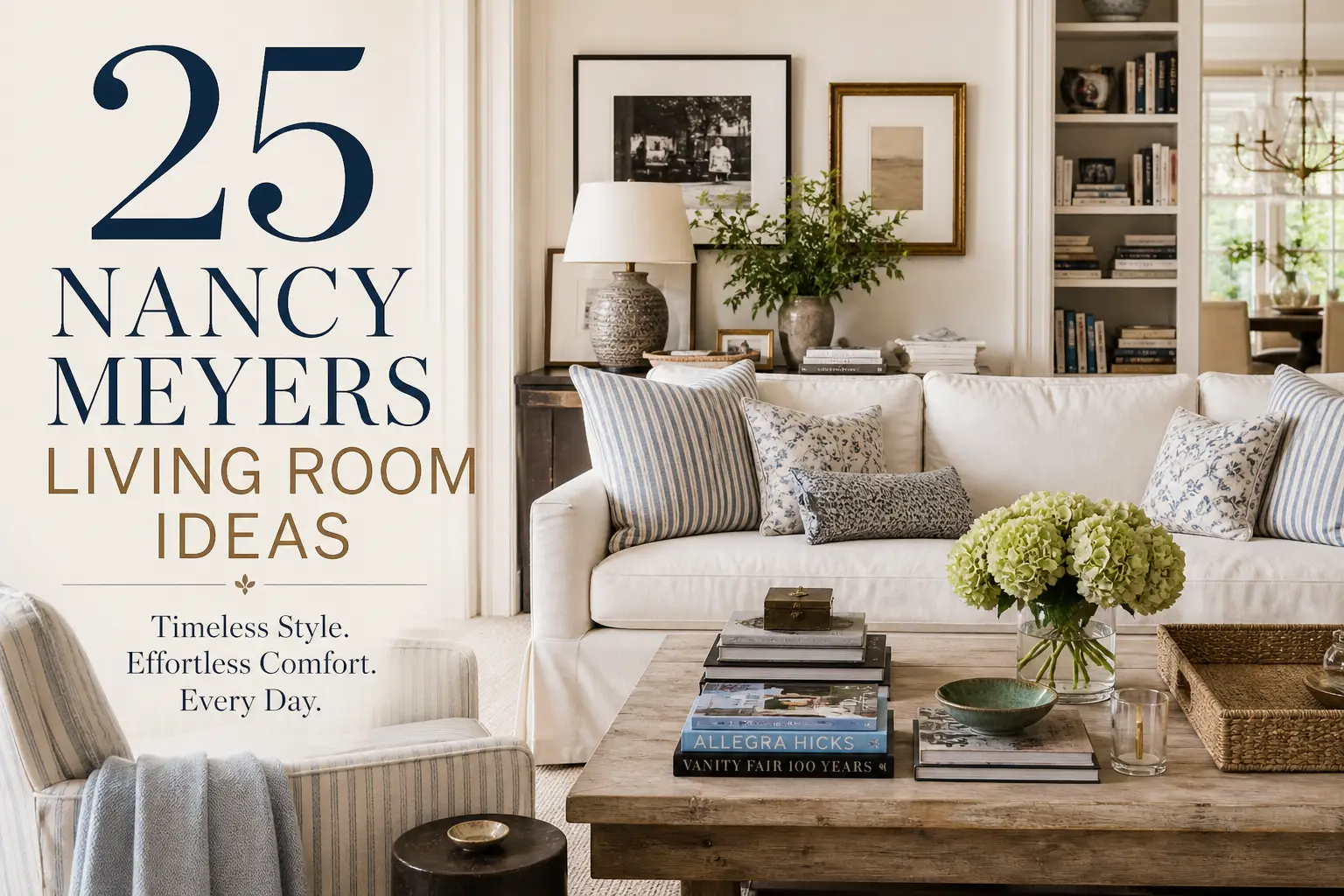
25 Nancy Meyers Living Room Ideas That Will Make You Want to Redecorate Immediately
The filmmaker’s signature aesthetic – creamy whites, soft linens, overstuffed sofas, and kitchens that make you hungry just looking at them – has become one of the most coveted interior design styles of our time. Here’s how to bring it home.

There’s a scene in Something’s Gotta Give where Diane Keaton’s character walks into her Hamptons beach house, and something shifts in you. You stop watching the movie. You start watching the room. The whitewashed walls, the cashmere throws draped just-so over a linen sofa, the stacks of hardcover books, the peonies in a ceramic vase – it all radiates a kind of effortless, sun-warmed abundance that makes you want to move in immediately.
This is the Nancy Meyers Effect. And it has been quietly colonizing our interior design ambitions since 1998.
The director – responsible for The Parent Trap, What Women Want, The Holiday, It’s Complicated, and Something’s Gotta Give – is as famous for her production design as for her films. Her sets, created in close collaboration with production designer Jon Hutman, have spawned a genre: the warm, impeccably layered, aspirationally liveable home that feels like a hug you can walk around in. Nowhere is this more evident than in her living rooms, which manage to feel simultaneously grand and cozy, curated and casual, expensive and inviting.
The good news? The aesthetic is highly replicable. It’s built on principles, not price tags. Here are 25 ideas, drawn from across her filmography, to bring that signature Meyers magic into your own living room.
1. Commit to a Creamy, Warm White
Forget bright white. The Nancy Meyers palette is softer, warmer, and more enveloping – think warm ivory, bone, and the color of good linen left in the sun. This foundational choice sets the tone for everything else: it bounces light, reads as effortless luxury, and creates a blank canvas that never feels cold.
2. Layer Your Whites
Here’s the secret that separates a great Meyers room from a flat one: no two whites in the room are exactly the same. The wall is one shade, the sofa cushions another, the throw a third, the shiplap ceiling a fourth. This layering of near-whites creates warmth, depth, and a sense of collected-over-time authenticity that a monochrome scheme can never achieve.
3. Go Big on the Sofa
Small, mean sofas have no place in a Nancy Meyers living room. The sofa should be generous – deeply cushioned, long enough to lie across with room to spare, and upholstered in a fabric that invites contact: linen, cotton twill, velvet in a muted tone, or a quality slipcover. This is not furniture for looking at. It is furniture for inhabiting.
4. Slipcovers Are Your Friends
Many of the sofas in Meyers films are slipcovered – a detail that reads as casual elegance rather than compromise. A well-made linen or cotton slipcover in ivory or pale grey gives a sofa that relaxed, Hamptons-summer quality and has the added practical virtue of being washable. Choose one that is slightly oversized and wrinkles naturally rather than pulling tight.
5. Stack the Throw Pillows
Pillow arrangements in Meyers rooms are abundant but never chaotic. A typical configuration might include two large square Euro shams, two standard-size pillows, and two or three accent pillows of varying sizes, all in coordinating but not matching fabrics – linen, cotton, perhaps one in a subtle texture. The palette stays tight: cream, ivory, soft grey, the occasional washed blue or sage.
6. The Essential Throw
Every Meyers sofa has at least one throw. It is never folded crisply. It is draped – casually, organically – over one arm or pooled at the foot of the sofa. It looks like someone just used it. This single detail communicates lived-in warmth more effectively than almost anything else you can do in a living room.
7. Natural Fiber Rugs
The living rooms in films like It’s Complicated and The Holiday feature rugs in natural fibers – jute, sisal, seagrass – often layered under a softer area rug in a complementary tone. This combination provides texture, warmth, and a grounding earthiness that perfectly offsets the soft palette above. Avoid anything too geometric or modern; organic weaves are the goal.
8. Built-in Bookshelves, Stacked with Intention
Nothing communicates the Meyers aesthetic more immediately than a wall of built-in shelving loaded with books. Not sorted by color, not sparse and gallery-like – actually stacked, with hardcovers horizontal and vertical, with a few objects (a small piece of pottery, a candle, a framed photograph) interspersed naturally. The shelves should look like someone reads.
9. Fresh Flowers, Always
Peonies in summer. Ranunculus in spring. Hydrangeas. White roses. Tulips. In a Nancy Meyers living room, fresh flowers are not an occasional indulgence; they are furniture. They sit on coffee tables, console tables, and side tables in ceramic or glass vessels, always abundant and always slightly imperfect-looking – not stiffly arranged, but generous and alive.
10. The Oversized Coffee Table
The coffee table in a Meyers room is substantial – large enough to anchor the sofa arrangement and serve actual coffee, actual books, and actual candles simultaneously. Stone tops, aged wood, and painted surfaces all appear across her films. What they share is scale and confidence: this is not a table that apologizes for taking up space.
11. Coffee Table Styling: The Meyers Formula
The styling of that coffee table follows a loose but consistent formula: a stack of hardcover books (not coffee table books, necessarily – just actual books), a candle or two, a small vase with a stem or two of flowers, perhaps a decorative object with some visual weight. Nothing is matching. Nothing is too precious. It looks like it was arranged by someone who reads and lights candles and didn’t overthink it.
12. Wooden Floors, Naturally Aged
Hardwood floors in muted, warm tones – honey oak, whitewashed wide-plank, aged walnut – run throughout Meyers interiors. They feel old in the best possible way: worn smooth, lived-on, warm. If your floors are darker or more yellow than you’d like, a large area rug in a natural tone can do significant corrective work.
13. The Reading Chair
Every Meyers living room has an obvious reading chair – typically an armchair or a pair of them, positioned near a window or a lamp, upholstered in a fabric that invites long afternoons. A wingback in aged linen, a club chair in soft leather, a slipcovered armchair with arms wide enough to rest a book on. This chair says: someone in this house reads for pleasure.
14. Warm, Layered Lighting
Overhead lighting in a Nancy Meyers living room is almost beside the point. The real work is done by table lamps, floor lamps, and the occasional wall sconce – all warm-toned, all at human height, all creating pools of soft light that make a room feel inhabited rather than illuminated. Lampshades are typically in linen, cotton, or paper in ivory or cream tones.
15. Candles in Multiples
Candles appear throughout Meyers films – on coffee tables, mantels, side tables, and bookshelves. They are rarely lit for drama; they are simply present as a matter of course, the way pencils are present in an office. Church candles in glass votives, pillar candles on stone holders, and tapers in simple holders all work. Buy more than you think you need.
16. The Fireplace as Anchor
In Something’s Gotta Give, The Holiday, and It’s Complicated, the fireplace is the room’s true center of gravity. Even unlit, it provides architectural weight and visual focus. A simple white-painted surround, a substantial mantel, and carefully considered styling above (a large mirror, an art piece, a collection of objects) gives a room its axis. If you don’t have a fireplace, consider how you can create a similar anchor – a large piece of art, a bold architectural element, or a television framed thoughtfully.
17. Mantel Styling
Mantels in Meyers rooms are styled with restraint and confidence: perhaps a large framed mirror, a pair of candlesticks, a small piece of sculpture, some greenery. Nothing cluttered. The mantel is not a shelf for storing things – it is a horizontal gallery, and everything on it earns its place.
18. Mix Old and New
One of the hallmarks of the Meyers aesthetic is the intelligent mixing of periods. An antique side table next to a contemporary sofa. A modernist lamp on an eighteenth-century console. Vintage ceramic vessels on a clean-lined coffee table. The room looks collected rather than decorated – as if its inhabitants have lived and travelled and loved beautiful things across decades.
19. French and European Antiques
A particular fondness for French and European antiques runs through Meyers interiors – a Louis XVI chair here, a painted Swedish dresser there, an aged iron mirror, a Belgian linen throw. These pieces give rooms their sense of time and history. You don’t need originals; good reproductions and genuinely aged pieces from antique markets both work beautifully.
20. The Large-Scale Mirror
A well-placed oversized mirror is one of the hardest-working elements in any Meyers room. It bounces light, creates the illusion of depth, and provides a strong vertical element that the soft horizontal layers of fabric and furniture need for balance. An aged gilt frame, a simple painted wood frame, or a bevelled antique glass mirror all suit the aesthetic. Hang it over the fireplace or lean it against a wall for a more casual effect.
21. Art That Feels Personal
Art in Meyers rooms is never generic. It tends toward the figurative, the landscape, or the abstractly emotional — oil paintings in aged frames, watercolors, drawings, the occasional photography print. The art looks chosen rather than placed, as if it arrived over years from different sources and means something to someone in the house. Avoid mass-produced prints and anything that matches the sofa.
22. Natural Materials Throughout
Wood, stone, linen, cotton, wool, jute – natural materials dominate the Meyers material palette. There is almost no visible synthetic in a Meyers living room. This choice creates a warmth and sensory consistency that photographs beautifully and feels, in person, genuinely restorative. Where possible, substitute natural for synthetic at every turn.
23. Plants and Greenery, Used Generously
Beyond cut flowers, Meyers rooms often include living plants — a large potted fiddle-leaf fig, trailing ivy in a stone pot, an olive tree in a terracotta container. These bring life, oxygen, and a small note of organized wildness into rooms that might otherwise feel too curated. Choose plants with presence; a small cactus on a shelf is not the Meyers move.
24. The Right Books, Displayed Honestly
Books in a Meyers living room are not decoration. They are evidence of a reading life. They appear stacked on the coffee table (current reads, presumably), arranged on shelves (the accumulated library), and scattered on side tables with bookmarks in them. This detail – the honest presence of actual reading material – communicates more about character and comfort than almost any furnishing choice.
25. Design for Living, Not Looking
Perhaps the most fundamental principle of the Nancy Meyers aesthetic – and the one most often missed in attempts to imitate it — is that the room is designed to be used. The sofa is for lying on. The books are for reading. The candles get lit. The flowers get put in water and left to open. There is no furniture swathed in protective covers, no decorative objects too precious to move, no corner too perfect to sit in.
The Meyers living room is, in the deepest sense, a room for living. It is warm and generous and slightly imperfect and completely, unmistakably human. And that is why, twenty-five years after The Parent Trap, we are still pressing pause on her films to stare at the rooms.
Putting It All Together
The Nancy Meyers aesthetic is not a checklist to complete but a sensibility to absorb. Its core values -warmth, generosity, the accumulation of beautiful and useful things over a life well-lived, the prioritisation of comfort without sacrificing elegance – are less about specific purchases than about a way of inhabiting space.
Start with the palette: warm, layered whites. Add texture upon texture – linen, cotton, jute, wood, stone. Bring in a few pieces with genuine age and story. Light everything softly. Put flowers on the table. Stack some books on the coffee table and leave them there because you’re actually reading them.
Then – and this is the crucial part – sit down on the sofa. Drape the throw over your legs. Light a candle. Stay a while.
That’s the whole point. That’s always been the whole point.
Whether you’re starting from scratch or simply refreshing a room that has stopped feeling like yours, the principles behind Nancy Meyers’ iconic interiors offer a generous, liveable, deeply human blueprint for a home worth coming back to.