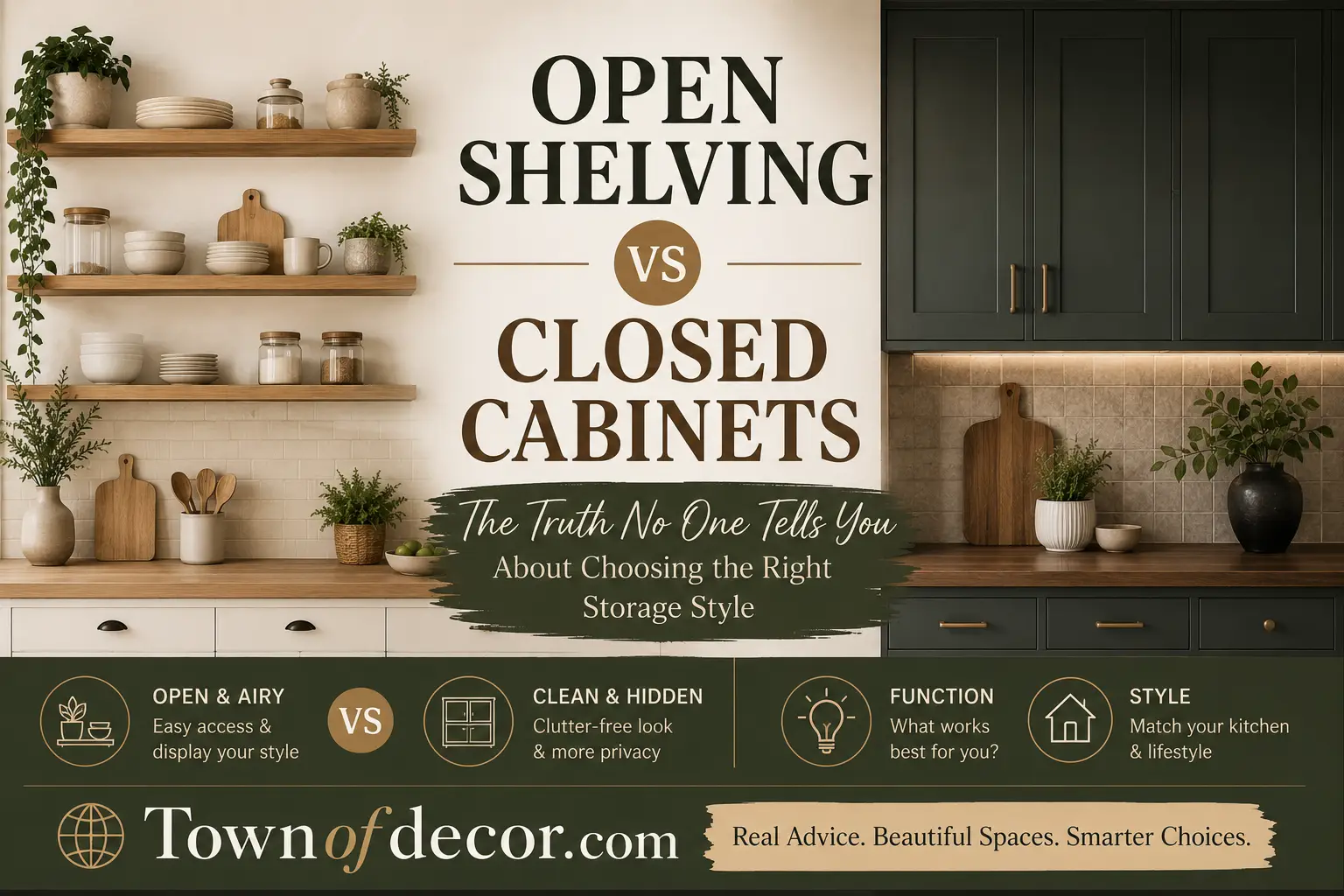
I have spent an embarrassing amount of time standing in my kitchen just… staring. Staring at my open shelves covered in mismatched mugs, a rogue bottle of olive oil that doesn’t belong there, and a cutting board I keep meaning to move. And then I look over at my neighbor’s kitchen on Instagram with those gorgeous floating shelves, perfectly styled ceramic bowls, and a little trailing pothos plant, and I think: why does mine look like a yard sale?
Here’s the thing nobody really tells you when you’re deep in a Pinterest spiral deciding between open shelving and closed cabinets: both styles have a very specific kind of person they work for. And if you’re not that person? It doesn’t matter how beautiful the inspiration photos look. You’re going to end up frustrated, dusty, or both.
So let’s actually talk about this. No fluff, no sponsored-post vibes. Just the real truth about open shelving vs closed cabinets and how to figure out which one is actually right for YOU. 👇
First, Let’s Talk About Why This Decision Even Matters 🤔
Storage style isn’t just about aesthetics. I know that sounds obvious but hear me out. The way you store things in your home directly affects how you live in it every single day. It affects how long it takes you to find your spatula. It affects whether guests feel relaxed or overwhelmed when they walk in. It affects how often you clean, how often you declutter, and honestly? How you feel when you wake up in the morning and shuffle into your kitchen half asleep.
Getting this wrong is a real thing. People gut renovate kitchens and bathrooms only to realize six months later that open shelving is driving them completely insane. Or they install floor to ceiling cabinetry and feel like their beautiful space has been closed off and boxed in. These are expensive, time consuming mistakes.
So yeah. This matters more than just which one looks cooler on a mood board.
The Case For Open Shelving 📦🌿
Let’s start with open shelves because honestly they get a lot of love online and for some genuinely good reasons.
It makes your space feel bigger and more airy 🌬️
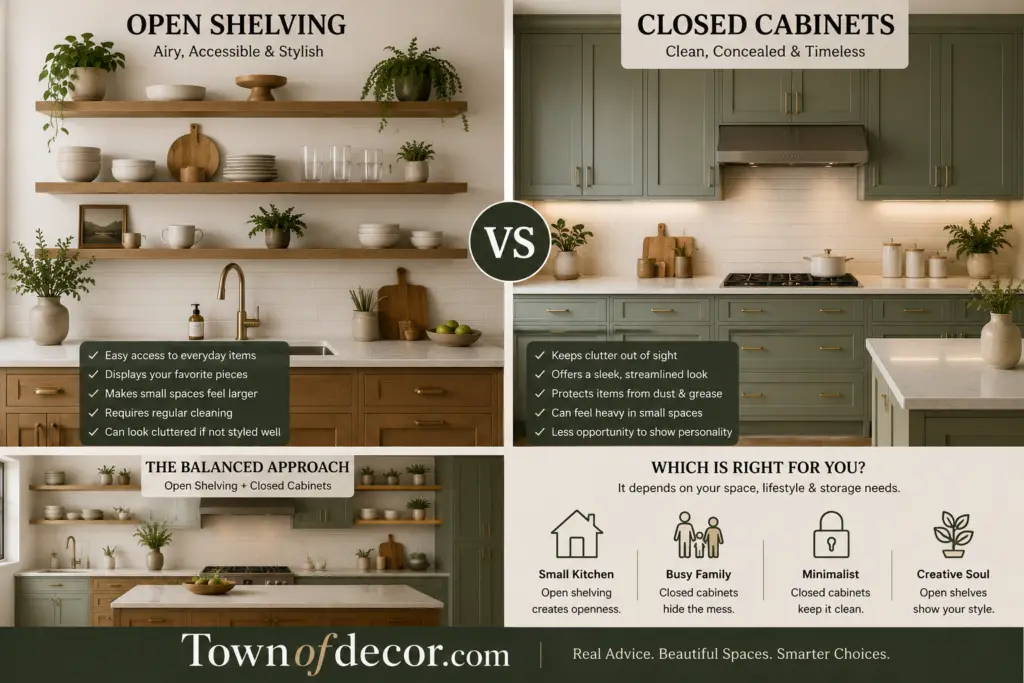
This is the big one. Removing upper cabinet doors and replacing them with open shelving instantly makes a kitchen or bathroom feel more open. When your eyes can travel through the shelf to the wall behind it, the room reads as larger. If you’re working with a smaller space, this is a real functional benefit, not just a style choice.
Everything is right there, within reach ⚡
When you reach for something and it’s immediately visible and accessible, cooking becomes faster. No opening three wrong doors, no digging through the back of a deep cabinet. Your most used items are just… right there. Grab and go. For people who cook a lot, this kind of accessibility is genuinely valuable.
It forces you to be intentional 🎯
Here’s one that surprised me when I first heard it but makes total sense. When everything is on display, you think more carefully about what you actually own. You’re less likely to hoard seventeen plastic containers with no matching lids because they’re visible. Open shelving naturally encourages a more curated, intentional approach to your stuff.
The aesthetic potential is real 🎨
Okay yes, let’s acknowledge it. When open shelving is done well, it looks incredible. A thoughtfully styled shelf with a mix of textures, a few plants, some beautiful dishware, and good lighting is genuinely stunning. It adds personality and warmth to a space in a way that a row of identical cabinet doors just cannot compete with.
It’s usually cheaper 💰
Upper cabinets are expensive. If you’re renovating on a budget, swapping some of them out for simple open shelves can save you a meaningful amount of money without sacrificing storage capacity. A few wooden brackets and a slab of pine, and you’re done.
The Honest Downsides of Open Shelving 😬
Alright here’s where I’m going to say the stuff that the beautiful home accounts don’t post about.
Dust. So much dust. 🌀
Everything on your open shelves collects dust. Constantly. If you’re not using something daily, it will have a fine layer of dust on it within a week or two. And in a kitchen? It’s not just dust. It’s grease particles floating through the air from cooking. Your white ceramic bowls will develop a subtle, sticky film that you have to wash off even before you use them. This is just physics. It’s unavoidable.
It requires actual styling skills 🖼️
Those gorgeous open shelf photos you’ve been saving? Those were styled by people who either have a natural eye for it or spent a lot of time learning. The average person puts things back after washing dishes in whatever order is convenient. That doesn’t look like a magazine. It looks like a shelf. Which is fine! But if you’re expecting your shelves to look curated without putting in consistent effort, you’re going to be disappointed.
Clutter becomes visible clutter 😩
With closed cabinets, a messy cabinet is invisible. Nobody knows. With open shelving, every bit of disorder is on full display. If you have kids, roommates, a busy life, or simply a personality that doesn’t naturally default to tidiness, open shelving will stress you out. It becomes visual noise, and visual noise affects your mood more than you’d think.
Not everything looks good on display 🙈
Cereal boxes. Cleaning supplies. Tupperware. A half used bag of rice held closed with a chip clip. Random batteries you’re not sure still work. This is the reality of most people’s storage needs. Open shelving assumes your stuff is Instagram worthy. A lot of our stuff is really, truly not.
It can date your home 📅
Design trends shift. Open shelving is having a big moment right now, but it was also popular decades ago and then became very uncool for a while. If you’re planning to sell your home in the next few years, be aware that a heavily open shelved kitchen may not appeal to every buyer.
The Case For Closed Cabinets 🚪💪
Now let’s give cabinets their proper respect because they really do solve a lot of real life problems.
They hide the chaos 🙏
This is the biggest practical advantage and it’s enormous. Closed cabinet doors mean that whatever is happening inside is invisible to the world. You can shove things in, close the door, and your kitchen looks completely clean and organized. For most people living real, busy lives, this is not a small thing. It’s a sanity saver.
They protect your stuff 🛡️
Things stored behind closed doors collect less dust, less grease, less ambient kitchen grime. Your dishes stay cleaner between uses. If you have a pantry cabinet, your food is protected from light and air exposure. Cabinets are genuinely better for preservation.
They work for any personality type 🧠
You don’t have to be a naturally tidy person. You don’t have to have an eye for styling. You don’t have to care about aesthetics to function well with cabinets. They are completely democratic in that way. A neat freak and a chaotic human can both have functional cabinet storage. Open shelving really does favor the former.
More total storage options 📏
Cabinets can go floor to ceiling. They can have pull out drawers, lazy susans, built in organizers, hidden trash cans, deep pantry pull outs. The amount of innovation in cabinet interior organization is honestly impressive. You can optimize storage density in ways that open shelving simply cannot offer.
Better for resale value 🏡
Most home buyers prefer cabinets. It’s just the data. When you’re selling, closed cabinetry is generally considered a safer, more universally appealing choice. Buyers can see themselves putting their own things in there. They don’t have to worry about how it’ll look with their stuff on display.
The Honest Downsides of Closed Cabinets 😤
Closed cabinets aren’t perfect either. Let’s be fair here.
They can make a space feel smaller and heavier 😶
A full wall of upper cabinets, especially dark ones, can make a kitchen feel like it’s closing in on you. In smaller kitchens, this can be genuinely oppressive. The visual weight of all those doors reads as bulk, and it can work against the openness you’re trying to create.
The forgotten zone is real 🕳️
You know that back corner cabinet where things go to die? Where the waffle iron from 2019 lives, and that rice cooker you were going to return, and honestly you’re not even sure what’s back there anymore? That’s a cabinet problem. Out of sight really can mean out of mind, and closed storage enables hoarding and forgetting in a way open shelving simply doesn’t.
More expensive 💸
Quality cabinets cost real money. The materials, the hardware, the installation. If you’re renovating on a budget, filling a kitchen with good cabinetry is a significant investment. You can offset this but it’s worth knowing going in.
Less personality 🎭
A kitchen full of identical cabinet doors can feel a little sterile, a little cookie cutter. It can feel like a showroom rather than someone’s home. This is fixable with hardware choices, paint color, lighting, and open shelf accents but it does take more intentional effort to make it feel warm and personal.
So How Do You Actually Decide? 🤷♀️
Here’s my honest framework for making this decision, and it’s less about aesthetics and more about self knowledge.
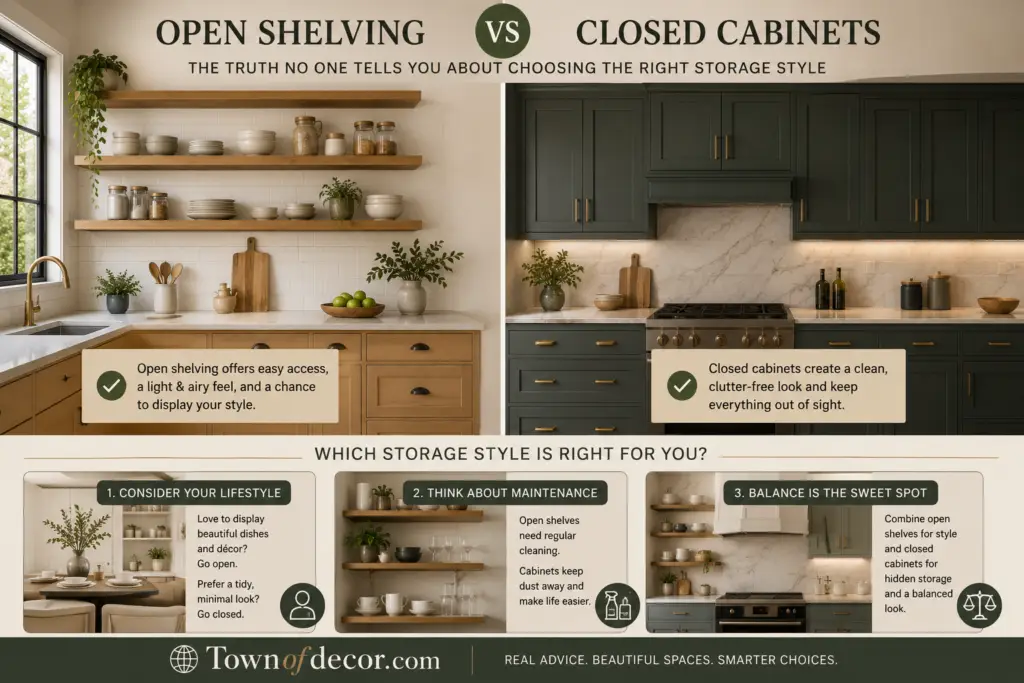
Question 1: How often do you tidy up? 🧹
If you do a full kitchen reset every day or every other day, open shelving can work for you. If your cleaning style is more of a “big weekend purge,” closed cabinets will save your sanity.
Question 2: What does your stuff actually look like? 👀
Take a real honest look at your dishes, your pantry items, your everyday objects. Are they things you’d be proud to display? Or are they a mix of mismatched, practical, real life items? There’s zero shame in the second answer. Most people’s kitchens fall into that category. Closed cabinets are made for real life.
Question 3: Do you cook a lot? 🍳
Heavy cooks often benefit from open shelving near their cooking zone because accessibility matters. But that doesn’t mean your whole kitchen needs to be open. Maybe the shelves above your stove are open, and everything else is behind doors.
Question 4: What’s your relationship with visual clutter? 🧘♀️
Some people find a full shelf of beautiful objects calming and inspiring. Others find it visually noisy even when it’s tidy. Know yourself here. If you’re someone who needs visual calm to feel mentally clear, closed storage is your friend regardless of what looks better in photos.
Question 5: Are you willing to maintain it? 🕐
Open shelving requires consistent styling and regular cleaning. Closed cabinets require periodic deep organizing so the forgotten zone doesn’t take over. Neither is zero maintenance. But be honest about which kind of maintenance you’ll actually do.
The Hybrid Approach (And Why It’s Often the Smartest Move) 🔀
Here’s what I’ve landed on after years of going back and forth: the best kitchens and storage spaces don’t commit completely to one or the other. They use both strategically.
Open shelves work brilliantly for things you use every day and are genuinely happy to display. Your everyday mugs. A few beautiful bowls. Cooking oils and spices you actually reach for constantly. Cookbooks you love. A plant or two.
Closed cabinets work brilliantly for everything else. The overflow. The stuff that’s not visually interesting. The things you use occasionally. The practical, unglamorous necessities of real life.
This hybrid approach lets you get the airy, personal, styled feeling of open shelving without sacrificing the sanity saving functionality of concealed storage. It’s not a compromise. It’s actually the most thoughtful version of the whole thing.
Some of my favorite examples of this done really well: lower cabinets with open floating shelves above on just one wall. A mix of glass front cabinets (which give you a hint of display without full exposure to dust) alongside solid door cabinets. A pantry that is fully closed while the everyday cooking zone has open shelves nearby the stove.
A Note on Trends vs Reality 📱🌍
I want to say this gently but clearly. A lot of the open shelving content you see online is produced by people whose job is to make their home look beautiful. Styled photos are styled. The mugs are arranged. The plants are watered and positioned. The lighting is good. The camera angle hides the messy corner.
That’s not a criticism. It’s just context. Those images are aspirational and that’s fine. But your home is a place you live in, not a set you shoot in. The right storage style for you is the one that actually fits your life, not the one that looks best in a photo.
Design choices should make your everyday life easier and more enjoyable. Not more stressful and more performative.
Final Thoughts 💬
If I had to summarize everything I’ve just said into one honest piece of advice, it would be this: ignore what looks good on your mood board and think really carefully about what fits your actual life.
Open shelving is beautiful, accessible, and great for certain personality types and lifestyles. Closed cabinets are practical, forgiving, and work for basically everyone. And a thoughtful combination of both is probably the answer for most real people living real lives.
There’s no universally right answer here. But there is a right answer for you specifically. And the only way to find it is to be honest about who you are, how you live, and what you actually need from your home.
Now go look at your kitchen with fresh eyes. 👁️✨
Got questions about your specific space? Drop them in the comments. I love talking about this stuff and I read everything. 💛