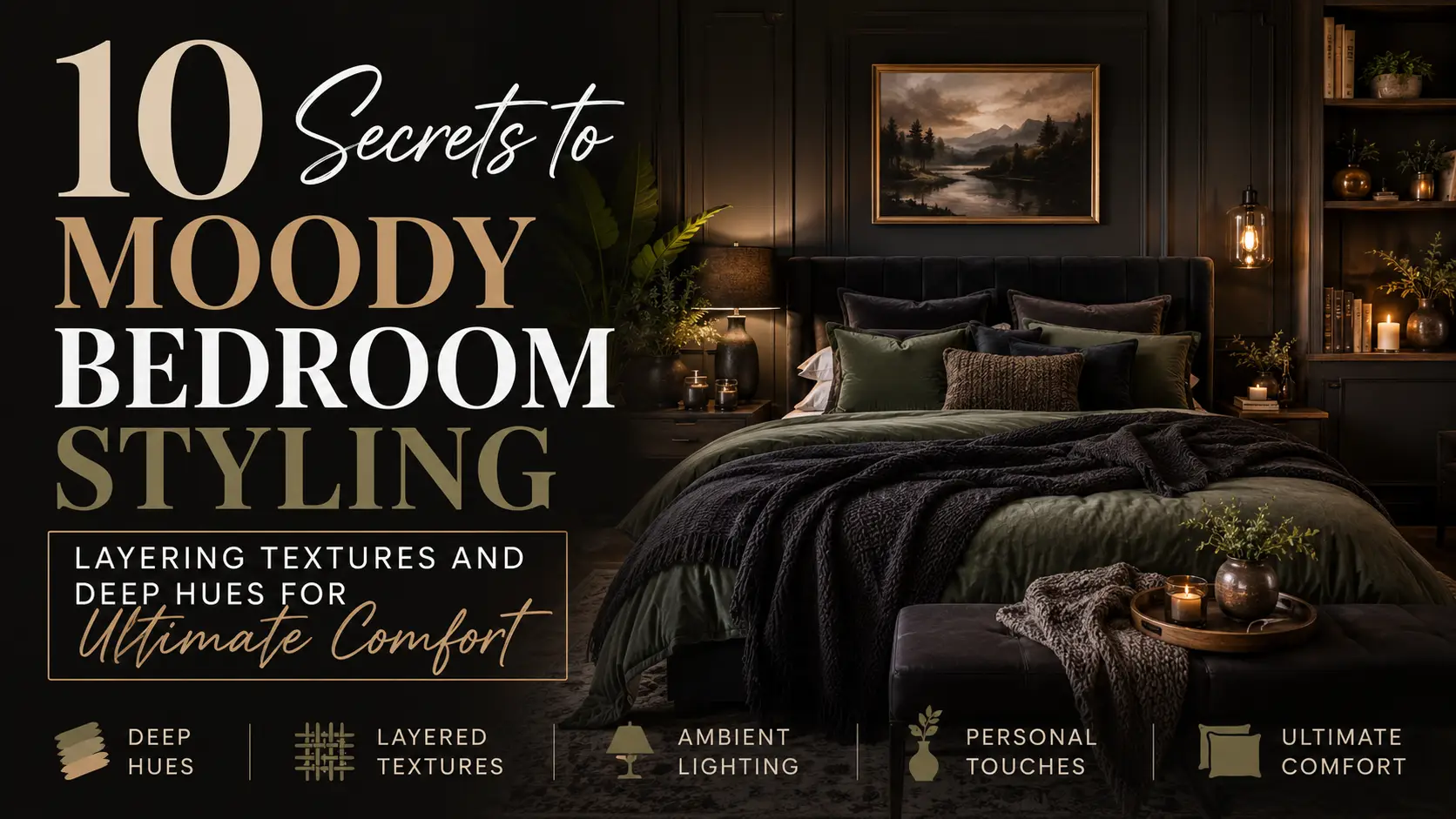
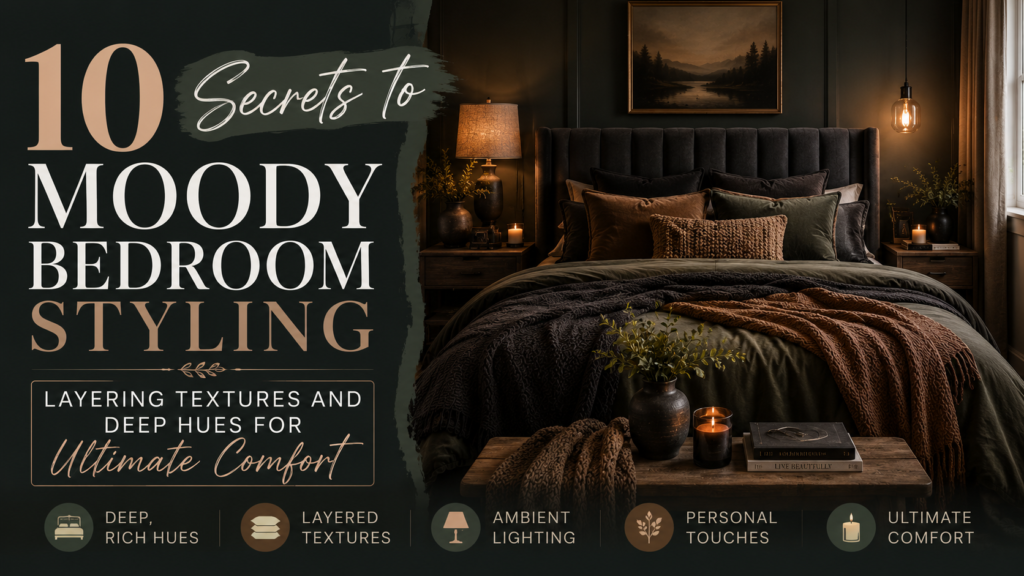
There is something quietly magical about walking into a bedroom that wraps around you like a warm hug on a cold evening. You know the feeling. The lights are low, the colors are rich, and every surface invites you to slow down, breathe, and just be. That is exactly what moody bedroom styling is all about, and honestly, it is one of the most underrated interior design approaches out there. 🌙
Most people shy away from dark, dramatic bedrooms because they are afraid the space will feel small or suffocating. But here is the truth: when done right, a moody bedroom feels more expansive, more intimate, and more deeply personal than any bright white room ever could. It is not about making things dark for the sake of it. It is about creating a sanctuary that feels intentional, layered, and completely yours.
So if you have been dreaming about a bedroom that looks like it belongs in a luxury boutique hotel or a cozy corner of a Parisian apartment, you are in the right place. These ten secrets will walk you through everything you need to know, from choosing your color palette to getting the lighting exactly right. Let us get into it. ✨
1. Start With a Color Story, Not Just a Color 🎨
The biggest mistake people make when styling a moody bedroom is picking one dark color and calling it a day. The real secret is building a color story, which means choosing a family of hues that work together and shift slightly depending on how the light hits them.
Think about the colors you find naturally soothing. Midnight navy. Forest green. Dusty plum. Warm charcoal. Terracotta with a deep, earthy undertone. These are all beautiful starting points, but none of them should live alone on your walls and call it done.
When you build a color story, you pick a dominant hue for your walls, then pull in secondary tones through your textiles, furniture, and accessories. If your walls are a deep forest green, your secondary palette might include warm brass tones, faded rust, and cream with a yellow undertone. The colors do not need to match. They need to belong together.
Take time to test your paint colors in different lighting conditions before committing. A color that looks brooding and beautiful in the paint store might read as cold and flat under your bedroom lighting. Paint large swatches and live with them for a few days. Your future self will thank you. 💚
2. Layer Your Textiles Like You Mean It 🛏️
If there is one single thing that transforms a bedroom from a room where you sleep into a place where you genuinely want to spend time, it is the layering of textiles. This is where moody styling really gets to shine.
The goal is to create a bed that looks like it has been lived in, in the best possible way. Start with a high quality fitted sheet in a natural fiber like cotton or linen. Add a flat sheet in a slightly different texture or a tonal color. Then comes your duvet or comforter, ideally in something with a little visual weight like a waffle weave, a velvet cover, or a thick linen blend.
From there, add a throw blanket. Not draped perfectly, but casually folded or tossed at the foot of the bed so it looks naturally lived in. Then pile on the pillows. Multiple sizes work best, and do not be afraid to mix textures here. A velvet pillow next to a chunky knit next to a smooth linen creates that visual richness that makes a bed look genuinely luxurious rather than staged.
The secret ingredient that most people skip is a bed runner or a folded quilt across the lower third of the bed. It anchors the whole look and adds another layer of depth. Choose something with a texture or pattern that ties back to your color story, and you will be amazed at the difference it makes. 🤎
3. Do Not Fear the Dark Ceiling ☁️
Here is a piece of advice that tends to make people nervous: paint your ceiling dark too. Or at least darker than you think you should.
In conventional interior design wisdom, ceilings are always white because it bounces light around and makes a room feel bigger. But in a moody bedroom, that white ceiling acts like a lid that breaks the whole atmosphere. It pulls you out of the immersive, cocoon like feeling you are trying to create.
When you extend your wall color up onto the ceiling, or choose a shade that is two or three tones deeper than your walls, something remarkable happens. The room feels intentional. It feels like a whole world rather than four walls with a ceiling slapped on top. The space becomes enveloping in the most comforting way imaginable.
If you are not ready to go full dark ceiling, try painting it the same hue as your walls in a flat finish. The lack of sheen will make it recede visually while keeping that unified, moody quality. Even a subtle shift makes an enormous difference. 🖤
4. Get Strategic With Your Lighting 💡
Lighting might be the single most powerful tool in moody bedroom styling, and most people do not give it nearly enough thought. The harsh overhead light that comes standard in most bedrooms is the enemy of atmosphere. It flattens everything and kills any sense of warmth or depth you have worked hard to create.
The secret is to use multiple light sources at different heights and different levels of brightness, so you can control the mood depending on what you need.
Bedside lamps are essential, and they should sit at a height where the light falls naturally over your reading or relaxing space. Choose bulbs with a warm color temperature, somewhere around 2700K, which gives off that golden, amber glow rather than the cool, clinical light of higher color temperatures.
Then add in a layer of ambient lighting that does not compete with your ceiling fixture. This could be a floor lamp tucked in a corner, a wall sconce on either side of the bed, or even a simple string of warm lights behind your headboard. Candles are also deeply underrated as a mood lighting tool, and their flickering warmth is genuinely impossible to replicate with electricity. 🕯️
Consider installing a dimmer switch if you do not already have one. The ability to shift from bright reading light to a barely there golden glow changes the entire personality of the room with a single movement of your hand.
5. Bring in Natural Materials and Organic Shapes 🌿
Moody does not mean cold. One of the most common misconceptions about dark, dramatic interiors is that they feel sterile or hard. The antidote to that is natural materials and organic shapes that add warmth and life to the room.
Think raw wood with visible grain, woven rattan, linen in its undyed natural state, stone accessories, clay pots, dried botanicals, and anything else that carries the energy of something made by hand or found in nature. These elements soften the drama of your dark palette and prevent the room from feeling like a set design rather than a real, lived in space.
Organic shapes are equally important. Curved furniture, irregular ceramics, draped fabric, and imperfect objects all contribute to a sense of ease and authenticity. Rooms that are filled exclusively with sharp lines and perfect symmetry can feel tense rather than restful, even when the color palette is beautiful. Soften the geometry with curves wherever you can.
A beautiful piece of driftwood on a shelf, a hand thrown ceramic vase on your nightstand, or a vintage rattan chair in the corner all do incredible work at making a moody room feel genuinely inhabitable. 🪨
6. Master the Art of the Gallery Wall 🖼️
Artwork is one of the most personal touches you can add to a bedroom, and in a moody space, it becomes even more significant. The walls are dark, the lighting is low, and any art you hang is going to carry real visual weight.
The key to a moody gallery wall is restraint combined with intention. You do not need to fill every inch of space. Choose a few pieces that genuinely move you, whether that is a dark, atmospheric landscape print, a moody abstract, an antique botanical illustration, or a black and white photograph that carries emotional resonance.
Frame your pieces in finishes that complement your palette. Dark wood frames, matte black, aged brass, and raw metal all work beautifully against deep wall colors. Mix frame styles slightly rather than matching everything perfectly, because that lived in, collected over time quality is part of what makes a moody room feel real.
Hang your art at eye level and think about the negative space around each piece. Sometimes a single large painting above the bed makes more impact than a dozen smaller pieces scattered around. Let each piece breathe and be seen. 🎭
7. Use Mirrors Strategically, Not Decoratively 🪞
Mirrors in a moody bedroom serve a very specific purpose: they bounce light around without disrupting the atmosphere, and they add depth to the space without lightening the overall feeling.
The trick is to position your mirrors so they reflect a light source, whether that is a candle, a lamp, or a window, rather than facing directly into the room and creating a flat, reflective wall. A mirror that catches the warm glow of a bedside lamp and scatters it softly around the room adds magic without effort.
Large format mirrors leaning casually against the wall feel more in keeping with a moody aesthetic than mirrors hung formally and centered. Vintage mirrors with aged, foxed glass are especially beautiful in dark rooms because their imperfections add character. The reflection is slightly soft and dreamlike, which suits the whole atmosphere perfectly.
Avoid placing mirrors directly across from your bed if it disrupts your sleep. But near a window or beside a lamp, they are one of the most hardworking decorative elements in any moody space. ✨
8. Choose Furniture With Character and Weight 🪑
Moody bedrooms call for furniture that has personality. This is not the space for flat pack minimalism or anything that looks like it could belong in any room in any home. You want pieces that feel specific, that have a history or at least the suggestion of one.
Dark stained wood, upholstered bed frames in velvet or textured linen, antique dressers with original hardware, and nightstands with character are all excellent choices. Look for furniture with interesting silhouettes, curved headboards, turned legs, carved details, or unusual proportions.
Upholstery is particularly powerful in a moody bedroom. A velvet bed frame in deep teal or forest green becomes a genuine focal point. A chaise longue in a rich fabric near the window transforms a corner into a reading nook that you will actually use.
Do not be afraid of mixing periods and styles. A vintage dresser next to a contemporary bed with a modern lamp creates that layered, personal feel that is the hallmark of truly beautiful moody interiors. The key is that everything should feel chosen rather than purchased as a matching set. 🖤
9. Add Living Elements That Breathe 🌱
Plants in a moody bedroom might seem counterintuitive because you associate dark rooms with dim light and most plants need sunlight. But there are several beautiful plants that thrive in lower light conditions, and they bring something irreplaceable to a dark, textured room: life.
The deep green of a pothos trailing across a shelf, the sculptural presence of a snake plant in the corner, or the dramatic leaves of a fiddle leaf fig near a window all add a dimension of living texture that no inanimate object can replicate.
Dried botanicals are another beautiful option, particularly for spaces where light is very limited. Dried pampas grass, eucalyptus, dried florals, and preserved moss bring organic texture and a slightly melancholy, romantic quality that suits moody interiors perfectly.
Even a small vase of fresh flowers on your nightstand, changed weekly, brings freshness and fragrance into the space. Scent is a deeply underrated element of bedroom atmosphere, and a moody room that smells as beautiful as it looks creates a genuinely multisensory experience. 🌾
10. Edit Ruthlessly and Leave Room to Breathe 🌬️
The final secret, and perhaps the most important, is knowing when to stop. Moody bedroom styling is not about filling every surface and hanging art on every wall. It is about curating a selection of beautiful, meaningful things and giving them room to be seen.
Clutter is the single greatest enemy of atmosphere. When every surface is covered and every corner is filled, the room feels anxious rather than restful, regardless of how beautiful the individual elements are. The moody aesthetic thrives on contrast, on the space between a beautiful object and the dark wall behind it, on the way a single candle on a clear nightstand draws the eye in a darkened room.
Go through what you have in your bedroom and be genuinely honest about what earns its place. If something does not contribute to the color story, the texture layering, or the overall feeling you are trying to create, find it a home somewhere else. Less truly is more when the things you keep are chosen with intention.
Once you have edited, stand in your room at the time of day when you most want it to feel beautiful, whether that is morning light coming through the curtains or the golden glow of evening with your lamps turned low. Look at what you have created. Then resist the urge to add more. 🕯️
Bringing It All Together ✨
Moody bedroom styling is not a trend. It is a design philosophy that prioritizes how a space makes you feel over how it photographs, though it tends to photograph beautifully too. It is about building a room that supports rest, reflection, and genuine comfort, a space that feels like it was made specifically for you because, in fact, it was.
The ten secrets above are not rules. They are starting points. Your moody bedroom might be a deeply saturated navy with brass accents and vintage linen. Or it might be a warm charcoal with terracotta textiles and trailing plants. Or perhaps a dramatic plum with aged wood and candlelight. All of these are right because they are specific, layered, and deeply personal.
Start with one wall, one piece of furniture, or one layer of textiles. Build slowly and let the room evolve. The most beautiful spaces are rarely designed in a single weekend. They are gathered over time, adjusted, and edited until they feel exactly right.
That is the real secret to moody bedroom styling. It is not about getting it perfect. It is about making it yours. 🌙🤎✨